


Last week, I had the privilege of visiting the United Arab Emirates as part of a fact-finding mission organized by the Middle East Institute and sponsored by the UAE embassy in D.C.. The purpose of the trip was to learn about the UAE’s AI strategy from senior officials and business leaders in Abu Dhabi and Dubai.
As a proponent of chip export controls on China, I was under no illusions as to why I was among the cohort of think tankers invited. The UAE sits at the intersection of the U.S.-China relationship as both one of China’s major trading partners and the site of the UAE-U.S. AI Campus: a 5 GW data center project led by G42, the Abu Dhabi-based AI cloud company, in partnership with Oracle, NVIDIA, Cisco Systems, and Softbank. The first phase of the project is a 1 GW compute cluster called Stargate UAE that is set to begin operating in 2026 with OpenAI as its anchor tenant and co-operator.
G42 previously held stakes in Chinese companies such as ByteDance and engaged deeply in China’s tech and biotech sectors. U.S. intelligence agencies also learned in 2022 that G42 allegedly provided Huawei with technology later used by the PLA to extend the range of their air-to-air missiles. Many U.S. lawmakers and policy analysts have thus had concerns that U.S. tech investments in G42 — and the UAE more broadly — could transfer sensitive IP and technologies to Chinese entities, potentially including model weights and advanced chips. However, with the May 2025 announcement of the U.S.–UAE AI Acceleration Partnership, a bilateral framework for technology cooperation that includes Stargate UAE, the tide in Washington has clearly turned.
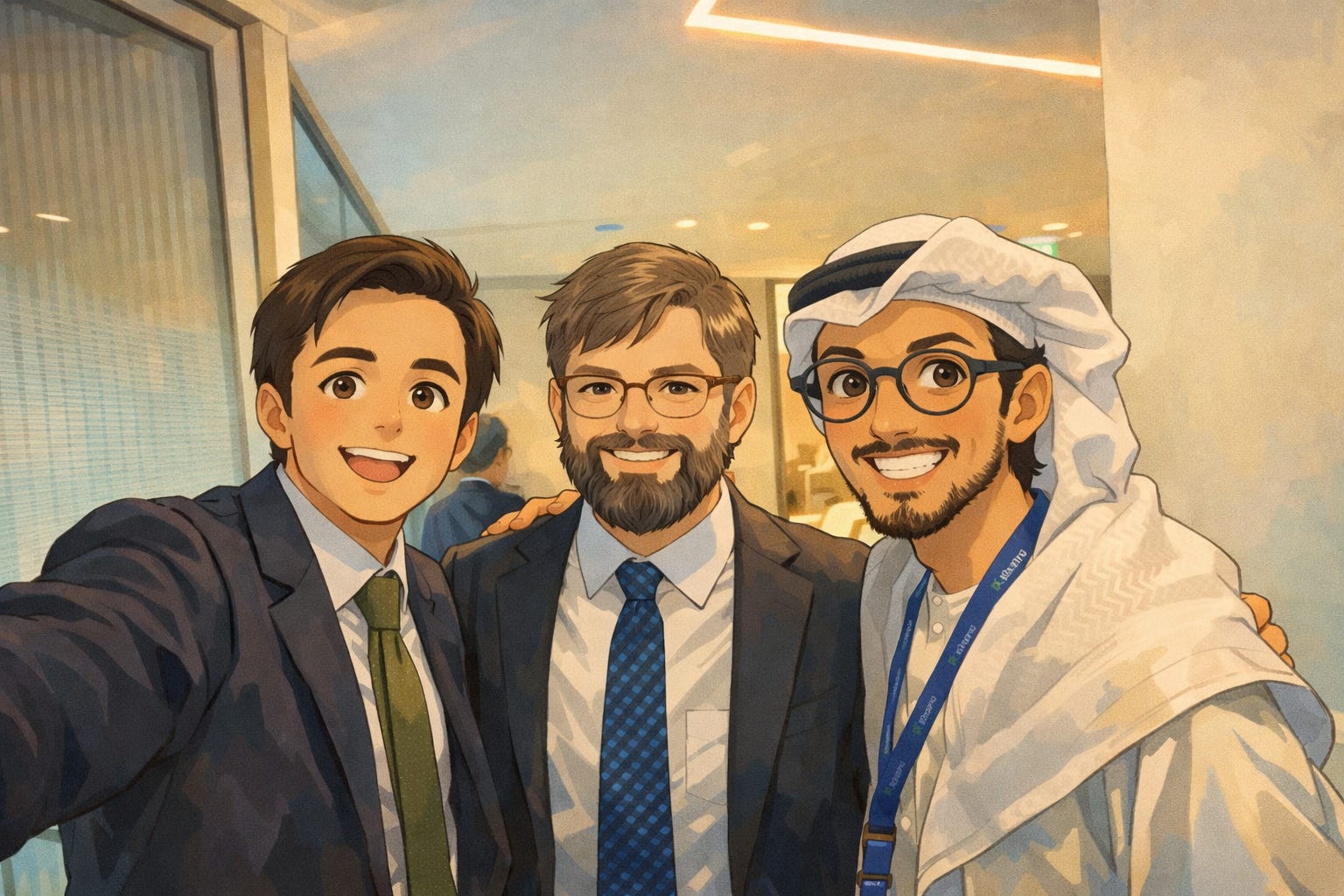
Our visit was largely structured around assuaging any residual concerns about the UAE’s technological exposure to China. In our nearly two-hour-long meeting G42’s chief global affairs officer, Talal Al Kaissi, every question we had was addressed candidly and convincingly, as he walked through their comprehensive divestment from the Chinese tech and manufacturing stack. He noted that even relatively benign Chinese equipment like cooling fans had been replaced at great expense. Meanwhile, while the UAE’s telecommunications infrastructure is still largely reliant on Huawei, G42 designed an air gap that connects to external networks using Nokia equipment and state-of-the-art multilayered encryption.
Talal spent nearly a decade at the UAE embassy in D.C. and several years advising the UAE Space Agency. The day after our meeting it was announced he had also just accepted the role of CEO of Core42, the sovereign cloud subsidiary of G42. Our conversation stood out given his technical depth, jumping from the intricacies of U.S. export control policy to the latest AI benchmarks and the unit economics of inference compute. Indeed, if not for his thobe — the traditional white Emirati robe — Talal could easily have been mistaken for a Silicon Valley tech bro in the best sense of the term. He even wore augmented reality glasses and mentioned he was experimenting with1 on an intermittent fasting and vegetarian keto diet.
Our meeting with G42 was followed by a walking tour of Khazna, a G42 subsidiary and the largest hyperscale data center provider in the Middle East; and M42 Genomics, the home of the Emirati Genome Program — an initiative to sequence the genomes of all 1.4 million Emiratis (participation in which the German-born think tanker on the trip was particularly aghast to learn is less than fully voluntary). The program had previously relied on Chinese sequencers supplied by BGI before they undertook a costly, voluntary transition to more expensive (American-made) Illumina sequencers.
I left this series of meetings with the impression that G42 was “all-in” on American tech, taking measures that not only exceeded their formal security assurances, but which imposed real and hard-to-reverse costs, thus making their commitments credible. This was reinforced in later meetings with Mubadala, one of Abu Dhabi’s largest sovereign wealth funds; MGX, the state-owned investment firm created to channel investments in AI; and Shorooq Partners, a traditional early-stage VC firm. All three had somewhat different constraints and mandates, and yet echoed that they were leaving money on the table by explicitly refusing to invest in many (though not all) areas of Chinese tech. This was conveyed most convincingly by Shorooq, an otherwise independent fund that admitted it would love to invest in Chinese startups if its backing from G42 didn’t make it a non-starter.
That being said, the full extent of the UAE’s investments in China are still relatively opaque. Mubadala was the largest sovereign-owned investor globally last year and remains heavily invested in many areas of China’s economy, including retail and logistics, biotech and life sciences, and energy and transportation infrastructure. The large number of distinct funds and family offices in the UAE (which often feature cross-ownership and shared board governance) also creates opportunities for shell-games. Just this month, for example, a leading UAE family office announced a partnership with a China-based investment group to support the entry of Chinese information technology companies in the Middle East and North Africa.
UAE-China commercial ties are also expanding more broadly. In November, a Chinese engineering firm was selected to lead the expansion to Dubai’s Al Maktoum International Airport. And at both the Abu Dhabi International Defense Exhibition in February and Dubai Airshow in November, Chinese defense and aerospace suppliers showed off new guided missile systems, military aircraft, and drone technologies to great fanfare. So while the UAE may not be investing in Chinese defense industries directly, they are nonetheless a major purchaser of Chinese arms, including munitions allegedly funneled to the Rapid Support Forces; the Sudanese paramilitary group that humanitarian groups and the Biden administration have accused of genocide.
In short, G42’s bet on American tech should be distinguished from the UAE’s orientation as a whole. As our broader conversations made clear, the UAE is relatively agnostic about where, and from whom, it acquires its tech. For now, the U.S. simply has the best AI chips on the market; chips the UAE is willing to make extreme concessions for in furtherance of its technological ambitions. We were told that the UAE rejects “Swiss neutrality” in no uncertain terms, aiming instead for strategic autonomy vis-à-vis the U.S., China and its regional competitors.
The UAE controls roughly $2.5 trillion in sovereign wealth across its pension assets and multiple state investment funds, ranking third globally in sovereign-owned assets behind the U.S. and China. This is a lot of wealth for a citizen population of only 1.4 million (the remainder of UAE’s 11 million total population comprises non-citizen expats and migrant workers). I thus found myself joking that the UAE should stand for the United Arab Endowments. Indeed, in more ways than one, the UAE often felt less like a country than a “fund of funds” in possession of a handful of gleaming city-states, making their leadership’s fluency in VC-speak much less surprising.
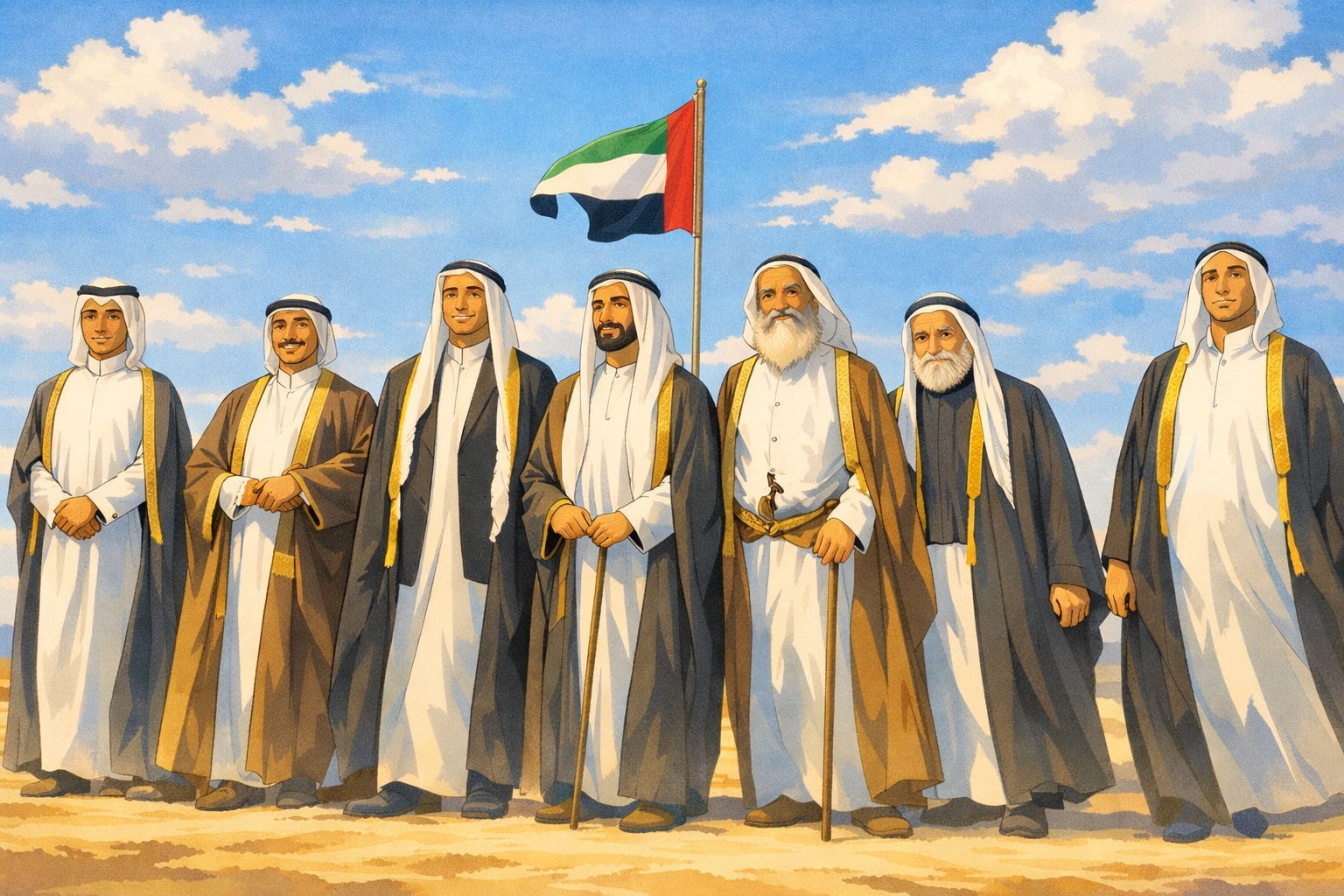
For most of its history, what is now the UAE consisted of independent tribal sheikhdoms along the southern Arabian Gulf coast. Political authority rested with ruling families who governed their emirate (read: province or principality) through tribal legitimacy and control of ports and pearling grounds (pearls were their main cash economy until prices crashed in the 1930s). After Britain intervened to secure shipping lanes to India in the early 19th century, the region became known as the Trucial States — not colonies, but protectorates with significant internal autonomy. This locked in ruling families and froze the political map in place, stabilizing issues of succession.
When Britain announced it was withdrawing from the Persian Gulf in 1968, the Trucial States were forced to choose between fragmenting or consolidating into a federation for collective security. On December 2, 1971, the United Arab Emirates was born through a political settlement between six emirates, with a seventh joining a year later. The founding logic was built on elite bargaining: Abu Dhabi provided wealth from the oil discovered the decade prior; Dubai secured autonomy over commerce and ports; and the remaining, smaller emirates consented to the arrangement in exchange for protection and fiscal transfers. This made the UAE less a centralized state than a consensual monarchy ruled by a council of seven Emirs, each with one vote, and with the Emirs of Abu Dhabi and Dubai serving as President and Prime Minister respectively.
Senior government officials in the UAE thus reject the notion that they are in any sense authoritarian or dictatorial. Nor are they an absolute monarchy like Saudi Arabia. Instead, as one official put it, the UAE is an “inclusive representative tribal system” with multiple power centers and processes for internal deliberation. I mentioned that I, too, hailed from an inclusive representative tribal system — namely, Canada — to uproarious laughter, although I wasn’t fully joking.
Canada was also born as a quasi-protectorate of the British Empire; a confederation of provinces with significant internal autonomy oriented around natural resources and trade, and with a periphery that eventually became dependent on fiscal transfers. While Canada is a parliamentary democracy, it is functionally governed by a technocratic, “Laurentian” elite committed to preserving “peace, order and good government” across generations. Given Canada’s ethnolinguistic diversity, our culture is rooted more in pluralism than any single, coherent national identity. Each province even has its own ruling families and cartels, leading to a form of consensus-oriented “brokerage politics” that rewards deal-making within the context of CEO-like ministerial powers and executive federalism.
The UAE’s origins in mercantile trade and tribal compromise likewise imprinted a distinctly pragmatic orientation on the country. Emiratis eschew religious extremism in favor of the virtues of doux commerce, including mutual respect and toleration. The UAE will soon be the first country in the Middle East with a Mormon Temple, for instance, while the Abrahamic Family House — a complex featuring a mosque, church, and synagogue side-by-side — is one of Abu Dhabi’s top attractions.
In fact, the only fleeting mention of Islam that I can recall during the trip was made by the executive director of Artificial Intelligence at the UAE’s Digital Economy Office. The Arab world had once been the seat of the Islamic Enlightenment, he noted, spurring many discoveries in science and mathematics — until restrictions were imposed on the printing press; an outcome he jokingly speculated was downstream of a Bootlegger-and-Baptist-style coalition between religious conservatives and incumbent calligraphers.
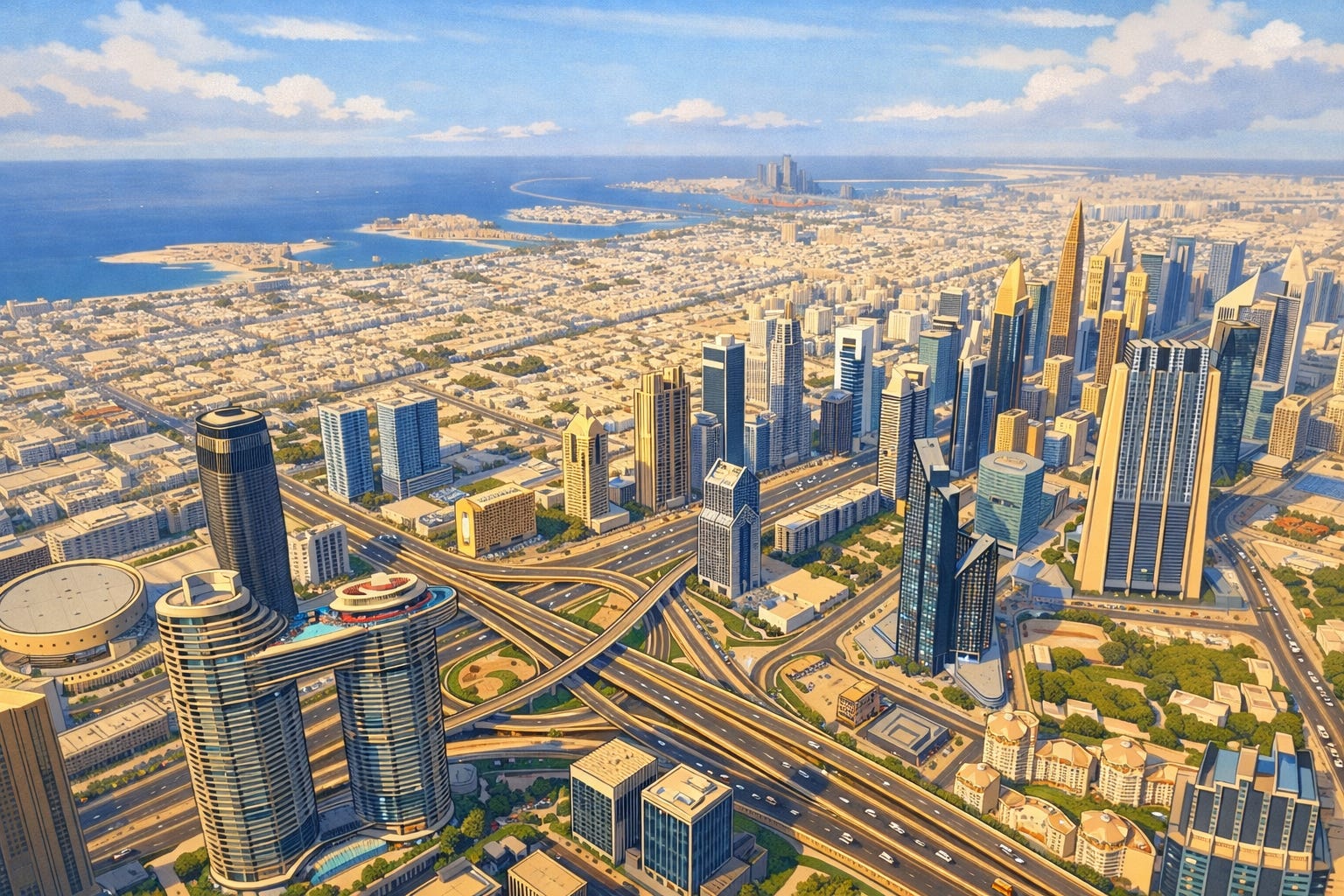
The UAE’s drive to become the Singapore-qua-Silicon Valley of the Middle East has made them one of the most AI and deep learning-pilled countries on earth. They are also one of the most institutionally-fortified governments against AGI and AI misuse. As I argued in my AI and Leviathan series, oil-rich Gulf monarchies are the closest thing to post-scarcity societies on earth today, with the institutional adaptions to match: sovereign wealth funds that mitigate the resource curse; ubiquitous surveillance systems to prevent Arab Spring-style regime change and subversion; cultural norms that promote privacy and discourage vices; and vertically-integrated polities that enable efficient, top-down political coordination. Outside of a brief lockdown in Dubai, for example, the UAE stayed open throughout the coronavirus pandemic thanks to their invasive contact tracing regime, sophisticated e-government, and early investments in wastewater surveillance.
There is a close mapping between government ideal types and corporate governance structures given their shared origins in transaction costs. Modern liberal democratic governments resemble membership co-operatives, with each owner qua citizen-member getting an equal vote. A country like the UAE, in contrast, is structured more like a joint stock corporation — or more precisely, a limited partnership between Emirs that evolved into a hierarchical corporation as the country grew. Similarly, law firms often start as co-equal partnerships but become corporate-like as lower tiers of associates and paralegals are hired over time. The key distinction between a partner and an associate — a citizen and a non-citizen — is whether they are an owner and thus residual claimant on the firm’s profit, or if their relationship to the firm is merely contractual. In the UAE, this maps to the distinction between Emirati citizens and everyone else: the foreign expats and migrant workers whose relationship to the UAE is less one of a shareholder than an at-will employee.
In turn, public policy in the UAE is largely conducted through same the currency of any large corporation: slide decks and strategy documents. UAE’s pandemic plan was one such strategy document, which they fortuitously finished in 2018. Similarly, the one “think tank” we visited, the Dubai Future Foundation, was run less like an American-style think tank than a vertically integrated skunkworks, complete with a robotics lab where an Indian tech worker could be observed riding a delivery robot they were piloting around the shop floor.
Yet despite their Singapore-envy and economic ties with China, the UAE’s tech aspirations are clearly downstream of a deeper affinity with the West. As I boarded my 16-hour return flight back to the United States, my thoughts thus turned to the equally apparent affinities between the Trump Administration and the Gulf, from the President’s push to create a U.S. sovereign wealth fund, to Elon Musk’s attempt to impose a corporate restructuring on the federal government, to America’s new ownership stake in Intel and other state-backed efforts to steer private capital toward the national interest.
All in all, I arrived home not only impressed by what the UAE has accomplished to date and bullish on their future, but also possessing a deeper appreciation of the nature and origins of America’s contemporary political situation.
I look forward to visiting again in the future.
a 5 year experiment*! https://x.com/i/status/2001842420502114383
Curious if you were able to get a sense of what the employee workforce looked like? Mainly locals or global talent?